September 16, 2026
Remote SIM Provisioning Explained: How eSIM Activation Works
eSIMs may be embedded in a device, but they need remote provisioning infrastructure to become useful connectivity tools. Discover how RSP works and how eSIM APIs can simplify the complexity for businesses building global connectivity products.
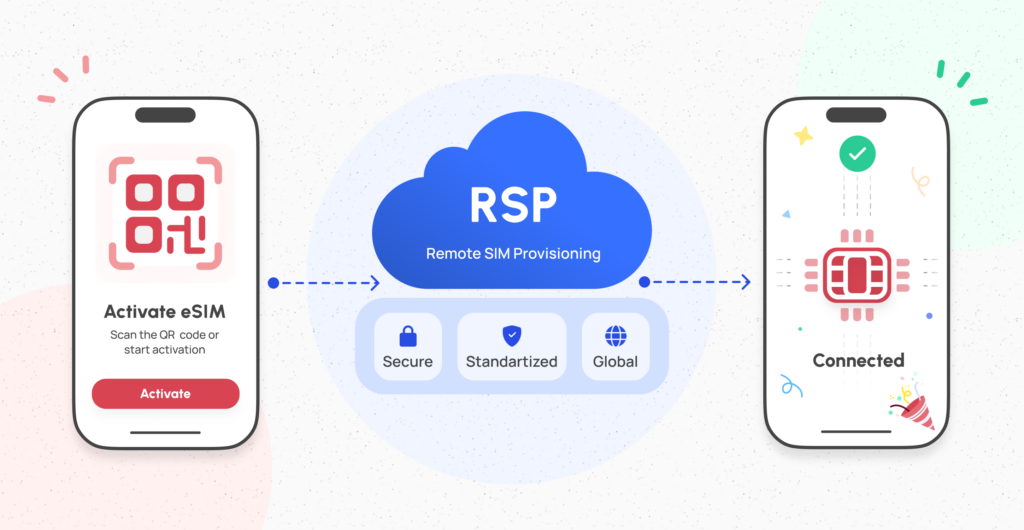
Remote SIM provisioning (RSP) is the technology that lets an eSIM download, install, activate, and manage a mobile network profile remotely, without requiring a physical SIM card.
Instead of inserting a SIM and waiting for a carrier to provision it manually, a compatible device securely connects to remote provisioning infrastructure and downloads its operator profile over the air (OTA).
Behind that seemingly simple “activate eSIM” button is a standardized architecture involving components such as the GSMA SM-DP+ and, in some legacy architectures, the SM-SR. RSP handles the secure delivery of carrier credentials from the mobile network to the eSIM, making near-instant, remote activation possible.
Put differently, at the heart of eSIM technology and the benefits it confers to end users is remote SIM provisioning.
In what follows, we will consider how remote SIM provisioning works and why it is essential to how you and your customers use eSIM. We’ll cover:
- Remote SIM provisioning: An introduction
- How remote SIM provisioning works: The GSMA SM-DP+/SM-SR architecture
- Remote SIM provisioning as the backbone of eSIM technology
- Integrating eSIM solutions with remote SIM provisioning
Do you want to learn more about how eSIM can benefit your business? Schedule a demo today to see how zendit’s eSIM API works.
1. Remote SIM provisioning: An introduction
Remote SIM provisioning, also known as over-the-air provisioning (OTA provisioning) is the process that allows mobile network profiles to be downloaded, activated, and managed on a device without a physical SIM.
It’s the foundation of embedded SIM technology, enabling end users to switch carriers, activate new plans, and manage multiple profiles directly from their devices.
Since this ability to switch between mobile network operators (MNOs) is one of eSIM’s key selling points, we can conclude that RSP is at the heart of the technology. End users enjoy flexibility as they travel or use multiple networks, while operators managing millions of devices enjoy scalability.
RSP can be divided into consumer RSP (for consumer electronics like smartphones, smartwatches, tablet computers, and fitness bands) and machine-to-machine RSP (for general and industrial IoT devices like smart meters, connected cars, logistics trackers, and industrial sensors, etc.).
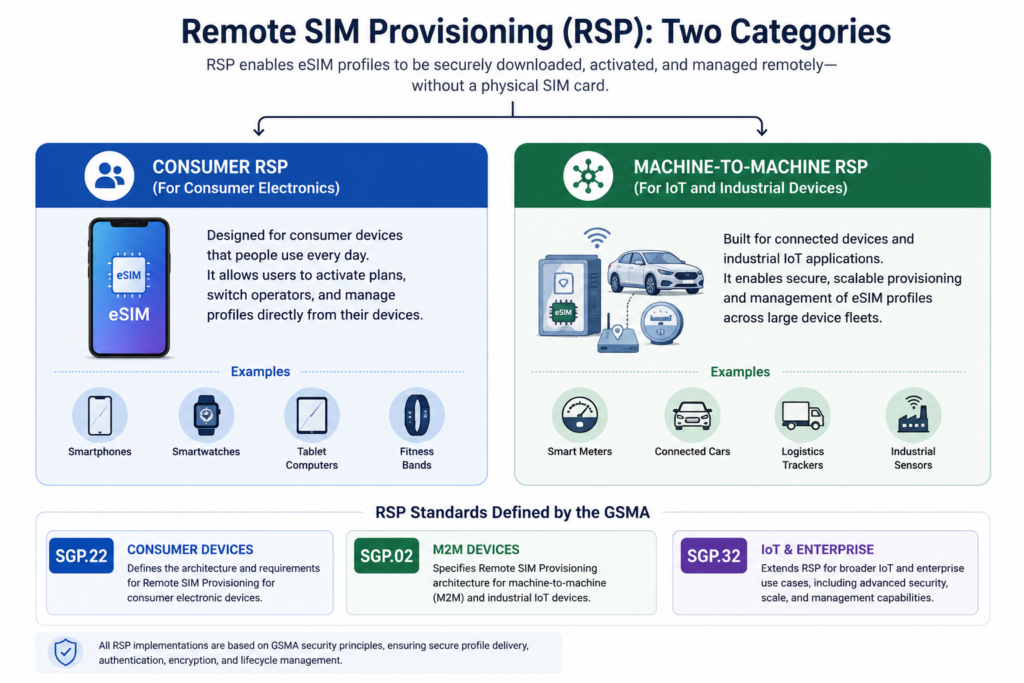
RSP often follows specifications defined by the GSM Association (GSMA), an association of mobile network operators and other mobile industry players. SGP.02 defines specifications for M2M RSP, SGP.22 defines it for consumer devices, while SGP.32 covers IoT and enterprise evolution.
These specifications are the rulebooks that ensure global interoperability and security between eSIMs, devices, and mobile operators.
2. How remote SIM provisioning works: The GSMA SM-DP+/SM-SR architecture
A better way to understand RSP is to consider the steps involved in a typical OTA provisioning.
We review these below:
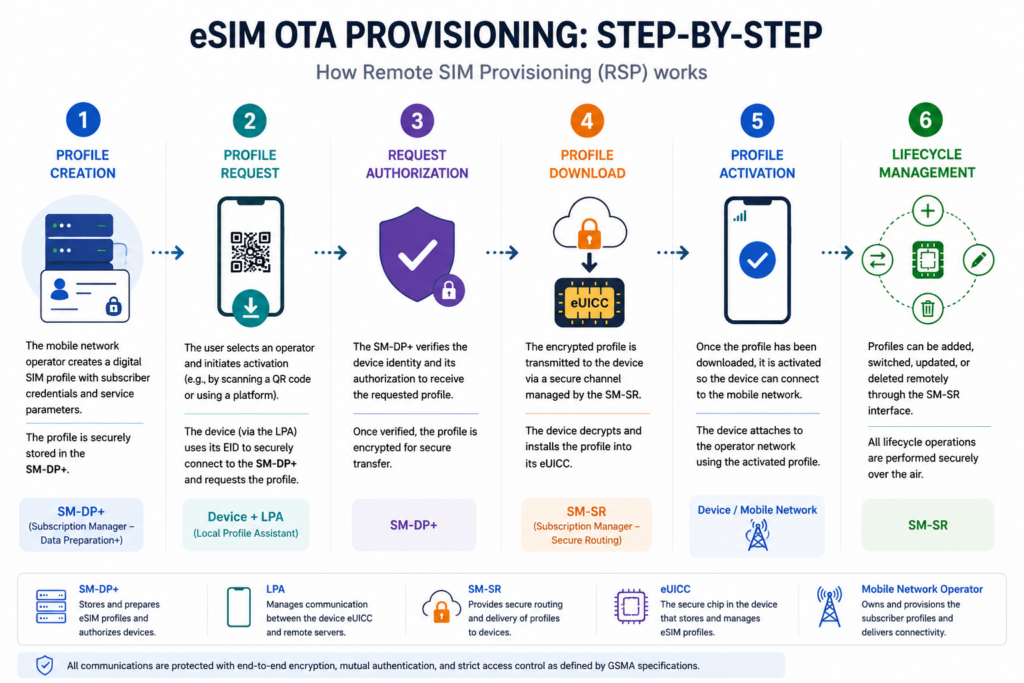
- Profile creation: The mobile network operator creates a digital SIM profile that contains subscriber credentials like the International Mobile Subscriber Identity (IMSI), Integrated Circuit Card Identifier (ICCID), security algorithms, authentication keys, and service parameters like subscription type, service entitlements, operator policies, and optional features.
This profile is securely stored in the Subscription Manager-Data Preparation+ (SM-DP+) system. The SM-DP+ is like a secure warehouse for eSIM profiles. It stores the profile and makes it available for download by an authorized eSIM.
- Profile request: The end user chooses a mobile network operator and proceeds to activate the eSIM profile associated with the operator. This is usually done through the scanning of a QR code or on a dedicated platform. For example, the eSIM IoT Remote Manager (eIM) is a dedicated platform for managing RSP for Internet of Things devices.
The eSIM inside a device has a unique identifier called an Embedded Identity Document (EID) or an eUICC Identifier.
It is through the EID that the device establishes a secure connection with the provisioning system. This involves sending a request to the SM-DP+ server to download the appropriate profile.
The Local Profile Assistant (LPA) is the software module embedded in an eSIM-enabled device that manages communication between the eUICC and the remote Subscription Manager servers.
- Request authorization: When the SM-DP+ receives a request, it verifies the device’s identity and its authorization to receive the requested profile. Once the device has been verified, the profile is encrypted for secure data transfer.
- Profile download: The encrypted profile is then transmitted to the device via a secure channel managed by the Subscription Manager – Secure Routing (SM-SR). Once received, the device decrypts and installs the profile into its eUICC, which is the component of the eSIM that allows remote SIM management over-the-air (OTA).
- Profile activation: Once the profile has been downloaded, it will be activated so the device can connect to the mobile network.
- Lifecycle management: eSIM provisioning also includes adding other profiles, switching between profiles, updating an existing profile, and deleting unwanted profiles. All of these happen remotely through the SM-SR interface.
3. Remote SIM provisioning as the backbone of eSIM technology
RSP and eSIM flexibility
Many enterprises use eSIM due to the convenience of switching between multiple profiles as their employees travel across the world for business purposes.
When an employee lands in a new country, they can switch to a mobile network carrier that is active in that place without incurring exorbitant roaming costs.
Enterprises with a global team also use eSIM for employee reward programs due to the same flexibility. They can purchase mobile data plans for employees across the world; in other words, there is something for everyone.
Flexibility also plays out when end users decide to switch between mobile network operators due to cost (cheaper plans) or quality (better network) considerations.
But what makes this flexibility possible?
It’s eSIM provisioning – the fact that multiple profiles can be installed on a single eSIM-compatible device. With physical SIM cards, such flexibility would require SIM swapping.
RSP and eSIM security
As we have seen, the SM-SR system uses end-to-end encryption and authentication to ensure that only the right device gets access to a mobile operator’s profile.
Each profile is securely prepared, transmitted, and managed, protecting user identity and network integrity.
“RSP implementations govern secure profile generation, secure element provisioning, attestation, and auditable lifecycle events (install, enable, disable, delete),” according to Ritwick Dey, co-founder of Panto AI Inc., an autonomous Quality Assurance platform. “For enterprise customers, these are not optional — they map directly to risk, regulatory compliance, and insurance boundaries.”
In a world where digitization often comes with cybersecurity concerns, this system ensures seamless and secure integration between mobile operators, device manufacturers, and service providers.
RSP and eSIM connectivity
For consumers, RSP ensures effortless activation and carrier switching, which saves time and money.
For enterprises, RSP makes it possible to manage large fleets of IoT devices remotely. It also enhances scalability since the same simplified process applies to 100 as well as 1,000 devices.
Even operators benefit from the cellular connectivity supported by RSP. They can reduce their operational costs as there is less need to produce physical SIM cards. Also, onboarding customers is easier since they don’t need to purchase and register new SIM cards.
Without GSMA remote SIM provisioning, eSIMs would merely be embedded chips with no way to receive or manage network credentials. RSP transforms them into a remotely configurable technology that supports global cellular connectivity.
Also, an improved remote provisioning system is expected to support the next evolution in global connectivity: iSIM.
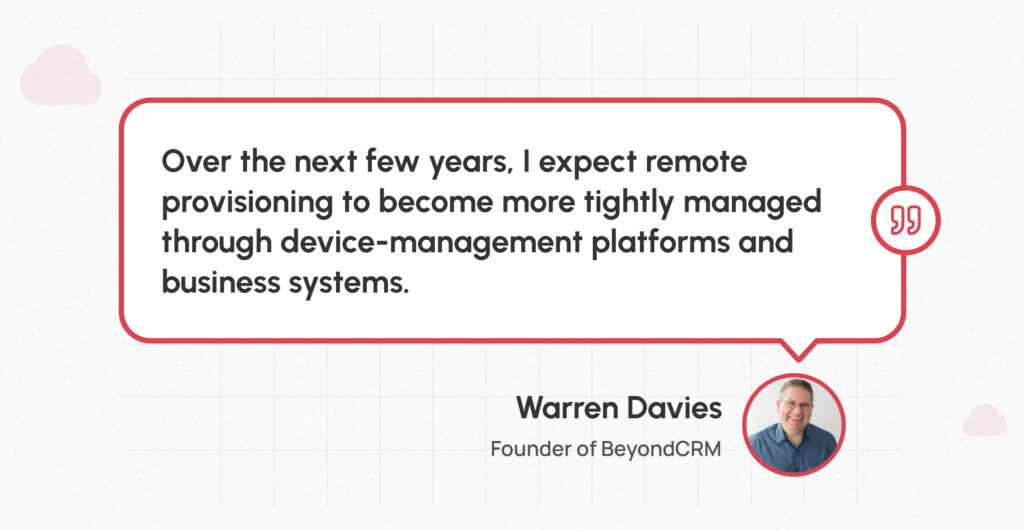
“Over the next few years, I expect remote provisioning to become more tightly managed through device-management platforms and business systems, with integrated SIM (iSIM) pushing the same idea further by building SIM capability directly into device silicon,” according to Warren Davies, the founder of BeyondCRM, a CRM firm.
4. Integrating eSIM solutions with remote SIM provisioning
Third-party platforms like zendit have made it possible for eSIM resellers and eSIM enterprise buyers to integrate eSIM solutions into their applications and platforms without having to set up their infrastructure.
These platforms can be set up through a simple eSIM API integration or a white-label eSIM solution that handles both backend and frontend.
Thankfully, these platforms also provide RSP solutions, allowing enterprise users and resellers to focus on non-technical aspects.
When considering an eSIM platform, enterprise users and resellers should prioritize three factors regarding provisioning, according to Dey:
- Coverage: They should focus on platforms that offer extensive operator agreements if they need global reach, or a self‑hosted/partnered SM‑DP+ if they need full data control and lower latency for provisioning
- API and commerce maturity: They should prioritize REST APIs for profile ordering/activation, webhook lifecycle events, multi-currency billing, rate cards, and a customizable storefront or SDK for white‑labeling.
- Compliance and security: They should select platforms that provide GSMA compliance, HSM-backed key management, audit logs, and SLA guarantees for profile downloads and lifecycle operations.
All of these and more are what zendit provides to eSIM resellers and enterprise users.
How zendit abstracts RSP complexity
When a customer purchases an eSIM through a platform powered by zendit (through API integration or full white-label adoption), the platform owner doesn’t need to manage the underlying provisioning infrastructure directly.
The zendit eSIM API handles the connection between the application and the eSIM supply/provisioning layer.
This abstraction means the business can focus on its own customer experience, billing, product logic, and user interface (if it’s not a white-label solution), while the eSIM infrastructure handles the technical provisioning workflow behind the scenes.
Below are the benefits that this abstraction provides:
- One API instead of multiple carrier integrations: A platform can integrate with zendit once rather than developing individual integrations for different mobile operators and eSIM provisioning environments. This is particularly useful for businesses that want to offer connectivity across multiple countries and networks.
- Access to a broad carrier network: zendit provides access to 5,500 plans from 193 carriers across 194 countries, allowing a business to build a global eSIM offering without separately connecting to every underlying network.
- Automated eSIM provisioning: Once an eSIM order is created, the API can facilitate the provisioning workflow needed to deliver the digital SIM profile to the customer’s device. This removes much of the manual work that would otherwise sit between purchase and activation.
- Faster activation: Because provisioning is remote, customers can receive and activate their eSIM without waiting for a physical SIM to be shipped or manually provisioned. zendit supports instant provisioning, which shortens the time from purchase to connectivity to a few seconds.
- A simpler developer experience: Rather than exposing developers to the complexity of individual carrier relationships and provisioning infrastructure, the API provides a standardized interface that their application can interact with.
Furthermore, zendit’s eSIM API can be quickly and seamlessly integrated with intelligent routing and scalable infrastructure. We also provide ready-to-use SDKs, which reduce the development effort needed for integration.
What is more? Our white-label solution totally removes the need for development. You can launch a fully branded eSIM storefront inside your website, app, wallet, or platform without building the customer-facing experience from scratch.
Are you ready to include eSIM connectivity services in your platform? Schedule a demo to see how zendit works or contact us to learn more about how we can help your business benefit from eSIM technology.
Takeaways
- RSP enables mobile network profiles to be downloaded, activated, switched, and managed remotely without a physical SIM card.
- From profile creation and authorization to secure download, activation, and lifecycle management, SM-DP+ and SM-SR facilitate the remote delivery and management of eSIM profiles.
- RSP makes eSIM connectivity more flexible, secure, and scalable. Users can switch networks remotely, while enterprises can manage large fleets of connected devices without physically replacing SIM cards.
- Instead of building provisioning infrastructure and individual carrier integrations, businesses can use a single API to connect their applications to the eSIM supply and provisioning layer.