Loyalty and rewards programs now abound as businesses seek to retain customers, motivate employees, and strengthen long-term relationships.
But simply offering points, discounts, and freebies doesn’t guarantee success. The most successful programs have clear objectives, offer genuine incentives that people want, make earning rewards easy, and minimize friction between redemption and fulfillment.
In what follows, we will consider these key elements of successful loyalty and rewards programs, drawing on insights from David Phelps, Senior Product Manager at zendit and Lilian Caballero, VP of Sales at zendit.
As professionals who have worked with businesses that have executed diverse loyalty and rewards programs, they will help us identify what works and what doesn’t.
We’ll cover:
- Why loyalty and rewards programs are becoming more popular
- Seven components of successful loyalty and rewards programs
- Implementing loyalty and rewards programs: Choosing the reward
- Implementing loyalty and rewards programs: Choosing the right platform
Do you want to improve employee retention and increase customer loyalty through loyalty and rewards programs? Book a demo now to see how zendit’s rewards and incentives embeddable can help.
1. Why customer loyalty and rewards programs are becoming more popular
More than 90% of companies now have a customer loyalty program, according to Queue-It, an online traffic management company.
What’s driving this interest in loyalty and rewards programs?
On the one hand, consumers are seeking better value and asking more of their retailers, according to a report by Deloitte, a consulting firm. About four in ten Americans are value seekers, according to them.
They also pointed out that loyalty programs are one way for businesses to provide this value beyond competing on price. “Depending on the industry, factors such as customer service, quality, ease of checkout, and loyalty programs can help attract consumers versus price alone.”
Younger consumers are even more willing to switch brands and move from one loyalty program to another, according to Boston Consulting Group, a management consulting firm. This has also spurred the wave of loyalty and rewards programs as companies compete for customer loyalty.
However, businesses are not just designing these programs to meet consumer expectations. Rather, they expect to derive business value from them.
Below are some business benefits of loyalty and rewards programs, according to the Decision Science Institute, a professional association of experts in managerial decision-making:
- Customer retention: Loyalty programs have a track record of building customer loyalty. In a global market where winning new customers is more expensive (5x-25x) than retaining repeat customers, rational and emotional loyalty are becoming more valuable.
- Affecting customer behavior: With discounts, two types of shoppers emerge: heavy shoppers who purchase regularly and light shoppers who buy only sporadically for lower-priced products. With rewards programs (delayed discounts), a third customer segment emerges: rewards shoppers. These shoppers are incentivized to buy a product to use credit from a past purchase.
In other words, rewards programs can increase sales (revenue) by offering delayed discounts, since loyalty program members are likely to spend more.
The study by Deloitte supports this.
“Most consumers (72%) say loyalty programs make them more likely to spend with their preferred brand, while over half (56%) increase their spending because of the program,” they noted.
The same trend emerges when we consider employee loyalty programs.
On the one hand, employees desire to be recognized and rewarded for their work beyond the base salary.
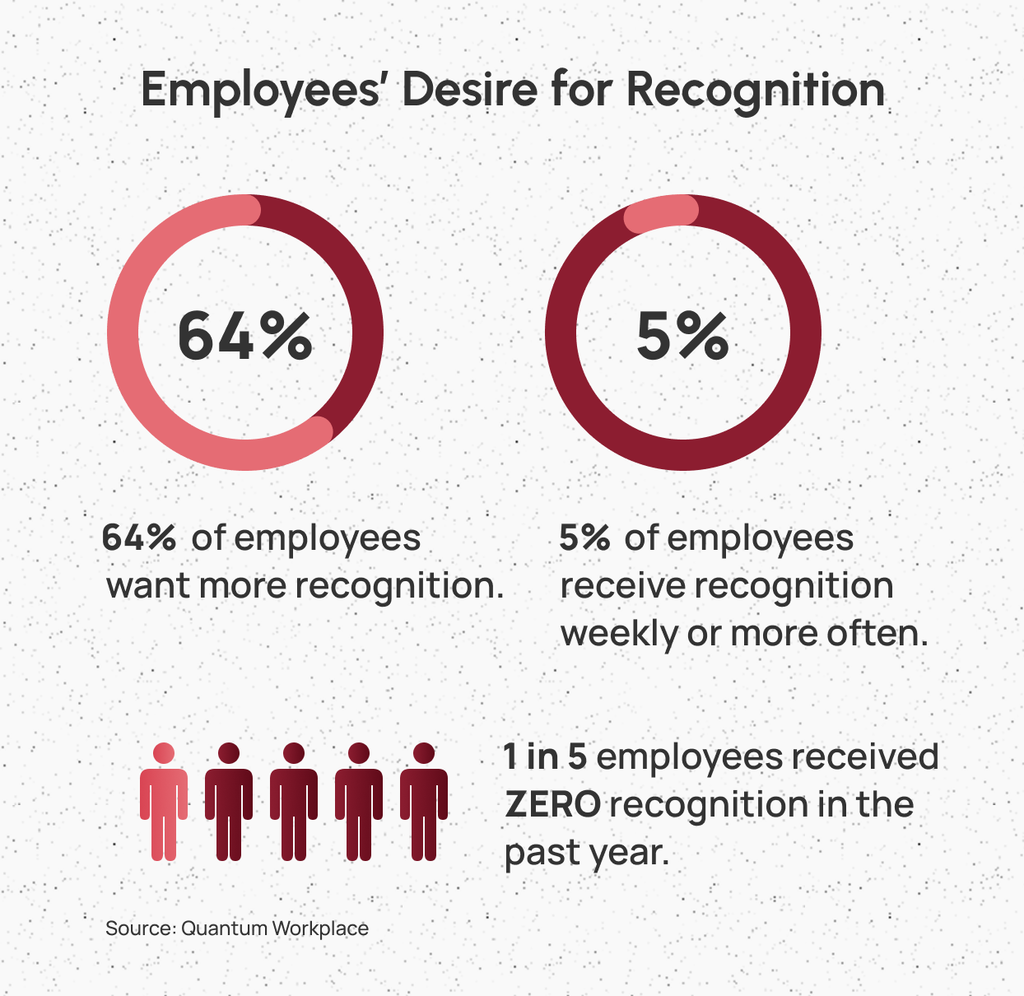
About 64% of employees want more recognition for their work, according to Quantum Workplace, a human resources software.
Also, employees are 4.8x more likely to value recognition when it comes with even a small reward. This ties in with research showing that employees value the benefits they receive from their jobs as much as, if not more than, base pay.
On the other hand, loyalty programs offer multiple benefits to businesses that embrace them. These include, according to Quantum Workplace:
- Engaged workforce: 80% of employees who are consistently recognized are likely to be highly engaged at work. Also, 85% of companies that spend 1% or more of their payroll on recognition notice a positive impact on employee engagement.
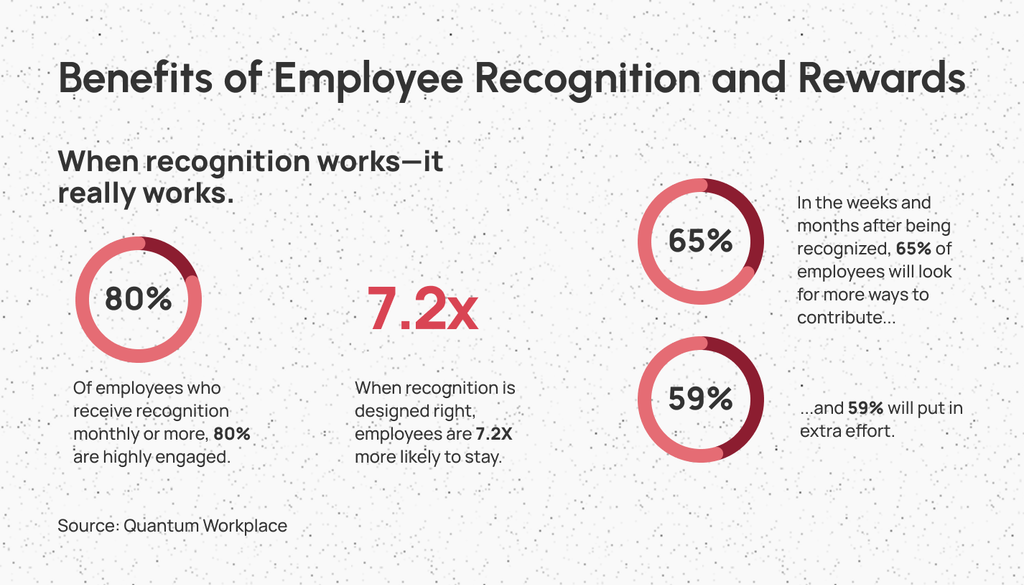
- More contribution at work: In the weeks after being recognized, 65% of recognized employees look for more ways to contribute, 59% put in extra effort, and 56% tend to stay longer.
- Increased employee retention: Because replacing an employee can cost up to 150% of that employee’s salary, employee retention matters to businesses. Recognition and rewards make employees more likely to stay.
2. Seven components of successful loyalty and rewards programs
Successful loyalty and rewards programs don’t happen by accident.
The chart below from Deloitte reveals a gap between the number of programs consumers opt into and the ones they engage with, with the latter lower than the former.
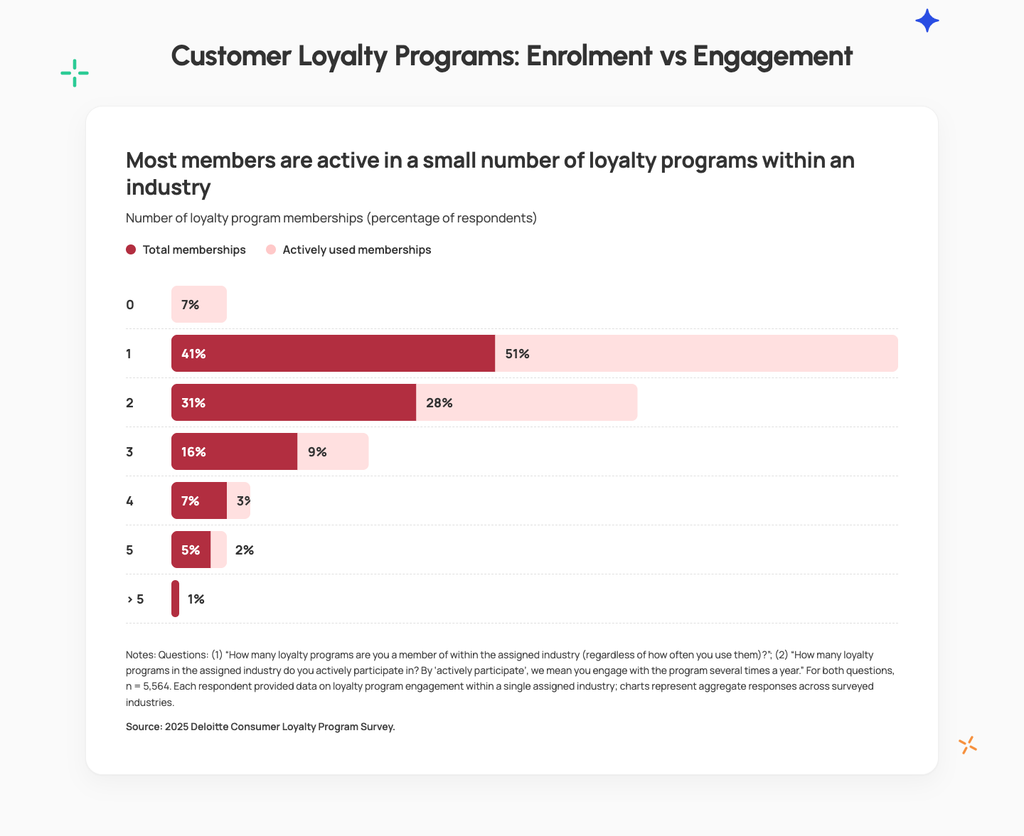
So what do you need to create loyalty and reward programs that customers and employees will engage with?
A look at popular loyalty program examples, including Amazon Prime Membership, Sephora Rewards, Starbucks Rewards, LEGO Insiders, The North Face’s XPLR Pass, and Nike membership, shows that successful programs share common features.
Below are seven key components of successful loyalty rewards programs.
1. Clear objective and audience
First, clarify the types of loyalty programs you are pursuing for the target audience.
There are two main types of loyalty and reward programs, according to Caballero:
- Employee and partner loyalty programs: You can reward employees, sales teams, and distribution partners for hitting some performance targets or reaching certain milestones. You can also reward all employees at different times as a form of recognition.
- Customer rewards programs: You can reward repeat purchases, referrals, customer engagement, or participation in promotional campaigns. Some programs can also target customers who have remained loyal based on years of consistent purchases, average order value (AOV), or customer lifetime value (LTV).
After broadly defining the target audience, you should identify the specific business outcomes you have in mind:
- Higher productivity level: Many employee loyalty programs aim for this. For general reward programs, you can set a company-wide productivity objective. If the reward focuses on specific employees or teams (e.g., a sales team), the productivity measure should focus only on the recipients.
- Lower employee turnover: Another popular objective is reducing employee turnover. This is usually appropriate for general reward programs that cover all employees.
- Higher customer retention ratio: Customer loyalty programs tend to focus on customer retention. You can use the customer retention ratio as a benchmark to measure the program’s success.
- Increased customer lifetime value (CLV): If you reward customers for their lifetime value, a higher CLV is a good objective for a customer loyalty program.
- Increased purchase frequency: If purchase frequency drives the reward program, then a purchase frequency objective is more appropriate.
- Improved customer engagement: Sometimes, the goal of a customer loyalty program is a more engaged customer base. Engagement measures can include app usage, website visits, event attendance, campaign participation, among others.
- New customers through referrals: Customer loyalty can also aim to create brand advocates and evangelists. In this case, direct referrals from existing customers are an appropriate objective.
- Promoting social causes: Values-based loyalty programs reward customers for behaviors that align with the company’s mission or social goals, such as charitable giving, community engagement, and participation in health and wellness programs.
Only with such clear objectives can you measure the success of your loyalty and reward programs.
Why is such measurement important?
It makes it easy to identify when a program underperformed so you can tweak it for better results.
2. Simple earn rules
One advantage of clear objectives is that they make it easy to set earning rules.
If the aim is to further increase CLV by rewarding high-CLV customers (based on a certain cutoff point), it is easier to set earn rules. For example, you can limit the reward to customers with more than $20,000 in CLV.
And if it’s a loyalty program that rewards single purchases, you should clarify what the rule is. For example: earn one point for every $1 spent or refer a friend and earn 500 points.
The same thing applies for employee loyalty programs. If you are rewarding those who have met some performance metric, clarify what the metric is so everyone will know how they qualify for the reward.
When your loyalty programs include gamification elements like badges for milestones, progress bars, membership tiers, leaderboards, spin-to-win challenges, and missions, clarify what each feature involves, the rewards available, and how users can earn them.
For example, if there are loyalty tiers, you should clearly outline the conditions for being in a tier and the special offers that attach to each.
3. A reward catalog people want
Many businesses take the easy path by offering rewards they can provide easily. But what’s easy for you to provide may be useless for your customers or employees.
This is where an understanding of your target audience helps.
If you are rewarding frequent travelers, an eSIM data plan may be more useful than company merchandise. Also, if you have remote workers in emerging markets, mobile top-ups may be more useful than discount vouchers.
“Gift cards are the most popular option, but eSIMs and mobile top-ups expand the range of ways to redeem a reward,” according to Phelps. “Being able to get data for travel, or top up the phone of a family member or friend to keep in touch, adds real value to a redemption catalog.”
The point is to understand your audience and give them what they are likely to want.
As we will see, this is one reason why some businesses prefer APIs with multi-product capabilities, like zendit API. This lets you choose new rewards for new audiences.
4. Instant redemption
The time lag between earning a reward and receiving it should be as short as possible.
Instant delivery through SMS, email, or app notifications makes it more likely the audience will find the reward valuable. In contrast, long redemption processes frustrate customers and employees and can make the reward feel less valuable.
“Ease of redemption and a variety of options to redeem loyalty rewards” are essential, according to Phelps. “The speed of receiving the items redeemed is also very important, since some programs leave customers waiting days or even weeks to receive their reward.”
As the chart below shows, this is one feature that all consumers strongly demand, irrespective of the generation:

5. Personalization and timing
Another way to make rewards feel more valuable is to personalize them to the recipients. This is where employee and customer data can be useful.
For example, you can reward an employee who loves playing games with platform gift cards from PlayStation, Xbox, Steam, or Nintendo. Similarly, you can give a customer who values the Christmas holiday an open-loop gift card as the holiday approaches.
Personalization matters most with younger customers.
“More than half of Gen Z (51%) and millennials (53%) say they would spend more at that brand if it offered a personalized experience, while just 38% of Gen X and 19% of boomers say the same,” according to Deloitte. “These patterns underscore that unlocking the next wave of loyalty lies in making personalization not just available, but meaningful, especially for younger consumers who expect it as the norm.”
BCG research has also shown how age and location affect the rewards customers value.
Tangible benefits, such as loyalty currency and discounts, are more common across all age groups, while other perks like free content, digital engagement, and access to experiences are becoming more popular among younger generations.
Also, while tangible benefits are common across all regions surveyed (US, Europe, and Asia Pacific), interest in benefits like member experience, gamified benefits, digital engagement, and access to experiences is more dominant in Asia Pacific.
Timing is especially important during the holiday or festive season.
One approach for points-based loyalty programs is to provide more value for fewer points during the holiday season
“A common approach in points-based rewards programs is offering higher-value cards for fewer points on popular brands as a holiday bonus,” according to Phelps. “Wholesale pricing helps offset the cost of a customer redeeming a reward, and limited-time bonuses create urgency to lock in the deal before it reverts to the regular points cost.”
Similarly, the festive season provides an avenue to explore more loyalty and rewards programs.
“During the festive season, these use cases naturally extend to year-end employee recognition, holiday customer appreciation, seasonal sales incentives, and promotional gifting,” said Caballero.
6. Measurement
This is where your objectives become useful.
Only by measuring actual results against those objectives can you tell whether your loyalty strategy is working or needs tweaks.
If you achieved your objectives, take note of what worked and reinforce it. If you didn’t, identify the challenges and adjust your strategy.
7. Scalability across countries
If your company operates globally, then your loyalty and reward programs should work across multiple countries.
This implies:
- Adapting to local reward preferences
- Supporting regional payment methods and multiple currencies
- Using a single platform that anyone can access from across the globe
3. Implementing loyalty and rewards programs: Choosing the reward
The choice of reward can make or mar a loyalty and rewards program. As noted above, the reward must be valuable, which depends on understanding the target audience and personalizing the reward.
Below are some of the most common reward types and when they tend to work best:
- Retail or closed-loop gift cards: You can offer gift cards from notable retailers like Amazon, Walmart, and Target.
When they are ideal:
- Your target audience has varied shopping preferences
- You have a large target audience, and personalization is impossible or very difficult
- Open-loop gift cards: Open-loop gift cards like Visa and Mastercard prepaid cards let users shop across multiple merchants rather than a single retailer.
When they are ideal:
- Your target audience prefers to choose their own gift
- You want a reward with a universal appeal, irrespective of location, spending preferences, and lifestyle
- Mobile airtime top-ups and data plans: These remain one of the most redeemed rewards in emerging markets. As smartphone penetration and internet usage rise, they’ll only become more popular.
When they are ideal:
- Your target audience is in regions with high smartphone usage
- Your target audience is a mobile-first audience
- Your reward programs are frequent
- eSIM data plans: Embedded SIM is becoming more popular due to its convenience, remote provisioning, and seamless network switching. As a result, eSIM data plans are now an established reward category.
When they are ideal:
- Your target audience includes frequent travelers, remote workers, and digital nomads
- Your target audience is in regions where eSIM adoption is high
- Prepaid utilities: With prepaid utility credits, customers and employees can pay for essential services like gas, water, electricity, internet, and television subscriptions.
When they are ideal:
- Your target audience is in markets where prepaid utility credits are popular: Latin America, Africa, and the Caribbean.
- Your target audience prioritizes rewards with immediate practical benefits
- Subscription rewards: You can provide access to streaming services, music platforms, and other digital memberships for a given number of months or years.
When they are ideal:
- Your target audience is digitally engaged and technology-oriented
- Customer engagement is an objective
- Merchandise and physical products: You can also reward customers and employees with free products.
When they are ideal:
- Your target audience is not too locationally dispersed for logistics to be cumbersome or expensive
- You want to showcase some of your products
- Reward earners are limited in number
- Experiential rewards: Unique and rewarding experiences like private sales, early product access, VIP events, concierge services, and meet-and-greet events are also popular rewards, especially for high-end customers.
When they are ideal:
- Your target audience belongs to a premium customer segment
- Building brand loyalty is the objective
- Early access: Rewards can also take the form of early access to sales, exclusive products, and free shipping, among others.
When they are ideal:
- Paid loyalty programs and tiered loyalty programs
- Your target audience values exclusivity, scarcity, or convenience
- Products are highly desired
- Cashback and account credit: Cashback rewards are one of the most redeemable rewards in loyalty and rewards programs. They are often the most popular rewards to use with loyalty cards.
When they are ideal:
- Your target audience prioritizes financial value
- The reward program has a universal appeal, and the audience has diverse interests
4. Implementing loyalty and rewards programs: Choosing the right platform
Given the range of rewards that customers and employees find valuable, executing a personalized loyalty and rewards program can seem daunting.
Imagine having to individually purchase eSIM, open-loop gift cards, prepaid utilities, and mobile top-ups for different employees across the globe. The process can be inconvenient and expensive, adding to program costs.
A better option is to use centralized platforms that offer access to multiple rewards. With a single integration, you can deliver instant, relevant loyalty and rewards to customers and employees worldwide. Instead of working with multiple platforms, you can implement entire programs on a single platform.
Many such centralized loyalty platforms now exist. But given what we have said about the components of a successful loyalty and rewards program, below are some features to look for when selecting one:
Support for multiple reward types
The main appeal of a centralized platform is access to multiple reward types from a single interface. Any platform you choose must cover the most popular digital rewards: eSIM, gift cards, prepaid utilities, mobile top-ups, and data plans.
Large product catalog
Covering multiple reward types isn’t enough if coverage depth is limited.
Each reward category should include a large number of providers.
Global reach
If your business is global, then the platform should support multiple currencies, locally relevant rewards, and local providers.
Instant reward fulfillment
Narrowing the time between redemption and fulfillment is crucial to recipients’ perception of value. You should prefer a platform with instant, real-time reward delivery.
Easy and quick integration
The platform should easily integrate with your existing CRM system, e-commerce platform, mobile application, POS system, and payment platform. Also, the setup process shouldn’t take long, so you can start implementing your programs immediately.
Analytics and reporting
We mentioned that measurement is what helps you improve the results of your loyalty and rewards programs. A good platform will provide reports about the rewards you purchased. You can then use them to evaluate how well the program met its objectives.
Security and compliance
The platform should also include security measures to protect you during initial integration and ongoing use. These include data protection measures, encryption, access controls, and fraud-prevention tools. The platform should also meet relevant regulatory compliance requirements.
Implementing loyalty and rewards programs with zendit
zendit is one centralized platform that helps businesses like yours power rewards and loyalty programs that are instant, relevant, and global.
With our rewards and incentives embeddable, you can deliver digital value in the form of eSIM, open-loop gift cards, closed-loop gift cards, prepaid utilities, mobile top-ups, and data bundles to your customers and employees from a single platform.
We provide access to a large catalog of rewards from multiple local and international vendors while handling delivery, availability, pricing, and scale behind the scenes. With us, fulfillment is instant, and you can access reports that will help you improve your programs.
You can connect to our platform in less than 24 hours without writing any line of code. All you need to do is fund your account, upload the recipients’ details, select the most relevant rewards, and send.
Are you ready to implement loyalty and rewards programs that drive measurable results? Sign up now for zendit’s rewards and incentives embeddable for quick and easy access to global vendors.
Takeaways
- Successful loyalty and rewards programs start with specific goals, whether to improve customer retention, increase purchase frequency, or reduce employee turnover.
- Gift cards, mobile airtime, data bundles, eSIMs, and prepaid utilities can make rewards more relevant to different audiences and markets.
- Complicated redemption processes and delayed fulfillment can undermine engagement, even when the rewards themselves are attractive.
- A centralized platform with multiple reward categories, global coverage, quick integration, and real-time fulfillment makes it easier to manage loyalty programs across markets.
Frequently Asked Questions
1. What is a loyalty program?
A loyalty program rewards customers or employees for specific actions such as repeat purchases, referrals, or meeting certain performance targets. Its goals include improving productivity, employee retention, customer loyalty, and revenue.
2. What are the key components of a successful loyalty program?
A successful loyalty program often has clear objectives and target audiences, simple earning rules, desirable rewards, instant redemption, personalization, performance measurement, and scalability across countries.
3. What are the main types of loyalty programs?
The main types are customer loyalty programs and employee loyalty programs. Customer loyalty programs often include cashback, referral, tiered, and points-based systems.
4. How do loyalty and rewards programs work?
Businesses establish specific objectives and earning rules that determine how customers or employees qualify for the stated rewards. The target audience can earn points, credits, or incentives when they meet the earning rules, and they can redeem them for gift cards, mobile top-ups, physical products, eSIMs, cashbacks, etc.
5. What rewards drive the highest redemption in a loyalty program?
Gift cards, cashback, mobile airtime and data, and prepaid utilities are popular for their practical or financial value. However, the appropriate reward depends on the target audience: age, location, and buying preferences. That is why personalization and reward variety matter.